What Happens Between the Panels Is What Breaks You
There's a moment in almost every great manga where you turn the page and nothing happens. No dialogue. No action. Just a face, a hand, an empty room — and then the next panel picks up somewhere else entirely. And yet somehow, that gap hits harder than anything the artist could have drawn.
That's not an accident. It's the whole game.
Manga operates on a principle that most storytelling mediums can't touch: the reader is an active participant in building the narrative. The panels show you selected moments. Everything in between — the movement, the sound, the emotional weight of what just happened — you fill in yourself. And when your imagination does that work, the result is something deeply personal. Something that belongs to you in a way a movie scene never quite can.
The Term You Need to Know: Closure
Scott McCloud, in his landmark book Understanding Comics, called this process "closure" — the mental act of connecting two separate images into a continuous experience. Every time your eye jumps from one panel to the next, your brain is quietly doing something remarkable: constructing reality from fragments.
In anime, the animators make every choice for you. The character's hand trembles at a specific speed. The music swells at a specific moment. You receive the emotion as a delivered package. In prose, the author describes the gap — they tell you what the character felt, what the room smelled like, how long the silence lasted.
Manga gives you neither. It hands you two snapshots and says: you figure out what happened in between.
The result is that your version of the scene is uniquely yours. Two readers can experience the exact same sequence and walk away with completely different emotional memories — both valid, both real, both shaped by who they are and what they've lived through.
Suspense Isn't Built in the Action Panel
Here's something that surprises a lot of newer manga readers: the most tension-filled moment in a sequence is almost never the climactic panel. It's the one right before it.
Think about how a skilled mangaka sets up a confrontation. You get a wide shot establishing the scene. Then a close-up on a character's eyes. Then — nothing. White space. A gutter between panels. Your brain races through every possible outcome before your eyes even reach the next image. That racing, that dread, that desperate hope — that's the emotional payload. The next panel just confirms or subverts it.
This is why manga can build psychological suspense that animation sometimes struggles to match despite having motion and sound on its side. A still image forces your nervous system to do the anticipating. You're not watching someone be afraid — you're briefly afraid alongside them, in your own body, in real time.
Series like Berserk and Vinland Saga are masters of this. The violence in those pages isn't shocking because it's graphic — it's shocking because of how deliberately the panel rhythm makes you brace for it. You see the wind-up. You feel the gutter. And then the impact lands.
The Quiet Scenes Hit Differently
It's not just action sequences where this mechanics shines. Some of the most emotionally devastating uses of panel space happen in completely quiet moments.
A character sits alone. The next panel shows the same character, same room, but the light through the window has shifted — hours have passed. No words. No internal monologue. Just the implication of time moving while someone stayed perfectly still. Any reader who has ever sat with grief or loneliness knows exactly what those hours felt like, and they project that knowledge directly into the gap.
This is why manga readers often describe rereading old favorites and feeling like the story has somehow changed. It hasn't. You have. The panels stay the same, but the life you're bringing to those gutters is different, and so the story reconstructs itself around your new emotional reality. That's an experience that's genuinely unique to this medium.
When the Page Turn Is the Twist
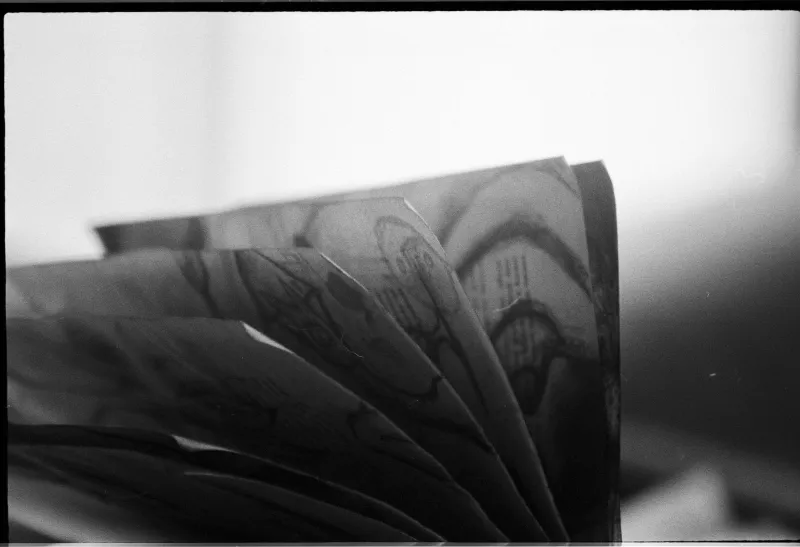
Smart mangaka also weaponize the physical structure of the book itself. The page turn is one of the most powerful tools in the format — a hard cut that functions like a held breath.
When a critical revelation lands on the first panel of a new page, the reader has no warning. There's no camera pan, no musical cue, no authorial aside softening the blow. You turn the page and reality has changed. The gap between the last panel on the previous page and that first panel after the turn becomes a kind of narrative cliff — you were standing on solid ground, and now you're not.
This is why so many manga readers describe certain moments as genuinely shocking in a way that the anime adaptation — even a faithful one — couldn't quite replicate. The adaptation smooths the cut. The manga leaves it raw.
Why You Keep Going Back
All of this explains something that manga fans know intuitively but rarely articulate: the scenes you return to aren't always the most dramatic ones. Sometimes you go back to a page that's mostly empty space, a single expression, a hand reaching toward something just outside the frame.
You go back because those pages still have room in them. They're not finished — they're waiting for you to complete them again, and each time you do, the experience is slightly different. That's a kind of storytelling that rewards rereading in a way that feels almost bottomless.
The gutter isn't dead space. It's where the story actually lives — in the gap between what the artist drew and what you imagined. And once you start noticing it, you'll never read manga the same way again.
That's the real hook. That's why this medium gets under your skin and stays there.